
At current prices, São Carlos is trading at a deep discount to realizable asset value, even under conservative assumptions.
Low leverage and high-quality assets limit downside risk.
Active asset monetization and capital returns provide a visible catalyst.
Upside from asset recycling, fees, and FII (REIT) optionality supports 2–3× returns over a 3-5 year time horizon.
Introduction
São Carlos is trading at a massive discount to its asset worth and is actively monetizing its assets to surface shareholder value and reduce the large discount. Additionally, the firm is moving to a capital-light business model serving as a consultant and thus spinning-off assets from its balance sheet. This transforms São Carlos from “just another real estate firm that is selling for a discount” into a self-liquidating balance sheet with an embedded asset-management option.
São Carlos presents an asymmetric bet with 2-3x upside within 3-5 years. This stems from multiple catalysts such as proactive management with incentives to liquidate and return capital to shareholders, net operating income (NOI) growth, improvement of occupancy in the office segment, continued asset sales at narrowing discounts that crystallize hidden net asset value (NAV), and a potential compression of cap rates that would increase asset values.
Company Background:
São Carlos is a Brazilian real estate company focused on acquiring, retrofitting, and monetizing high-quality office assets and power centers, primarily in São Paulo and Rio de Janeiro areas. Founded in 1989 and listed publicly in 1999, the company is controlled by the founding families of the well-known investment firm, 3G Capital. The culture and quality of the controlling shareholders as shrewd operators are well documented, including in the book ‘Dream Big’.
Currently, the founding families still control around 55%, and only a small percentage is free-floating. Having such great capital allocators as controlling shareholders is a massive plus and should add confidence to the value accretive potential of the company.
Throughout 2024 and 2025, the company has undergone a strategic shift from a traditional “owner-operator” model to an asset-light model. This move marks a fundamental change in how the company creates value.
The primary motivations include:
Unlocking Value: For years, the company’s stock price traded at a significant discount relative to its NAV. Management recognized that the market was not fully valuing the physical “bricks” they owned. By selling assets and transitioning to a management role, they could “unlock” this hidden value for shareholders.
Capital Efficiency and Scalability: Under the old model, growth required massive capital expenditures to buy new buildings. The asset-light approach allows the company to grow its Assets Under Management (AUM) using third-party capital, primarily through real estate investment trusts (FII as they are known in Brazil).
Reducing Financial Leverage: Selling large portfolios, such as the R$ 837 million office sale in late 2025, allows the company to pay down debt, significantly reducing financial risk and interest expenses.
New Revenue Streams: Instead of relying solely on rent, the company is pivoting toward a service-oriented model. By acting as a real estate consultant and manager for the funds that buy its properties, it generates recurring fee income (management and performance fees) with much higher margins.
The company has implemented this strategy through:
Asset Recycling: Selling mature “trophy” assets (like the EZ Towers or Morumbi Office Tower) to recycle capital into new opportunities and return capital to shareholders.
FII Integration: Many sales involve receiving a portion of the payment in subordinated shares of the purchasing Real Estate Fund. This keeps São Carlos with “skin in the game” while offloading the majority of the capital burden.
Service Transition: In recent deals, such as the sale of its retail and office portfolios, São Carlos has signed contracts to remain the Real Estate Consultant, maintaining its operational influence and fee-earning potential without the heavy balance sheet.
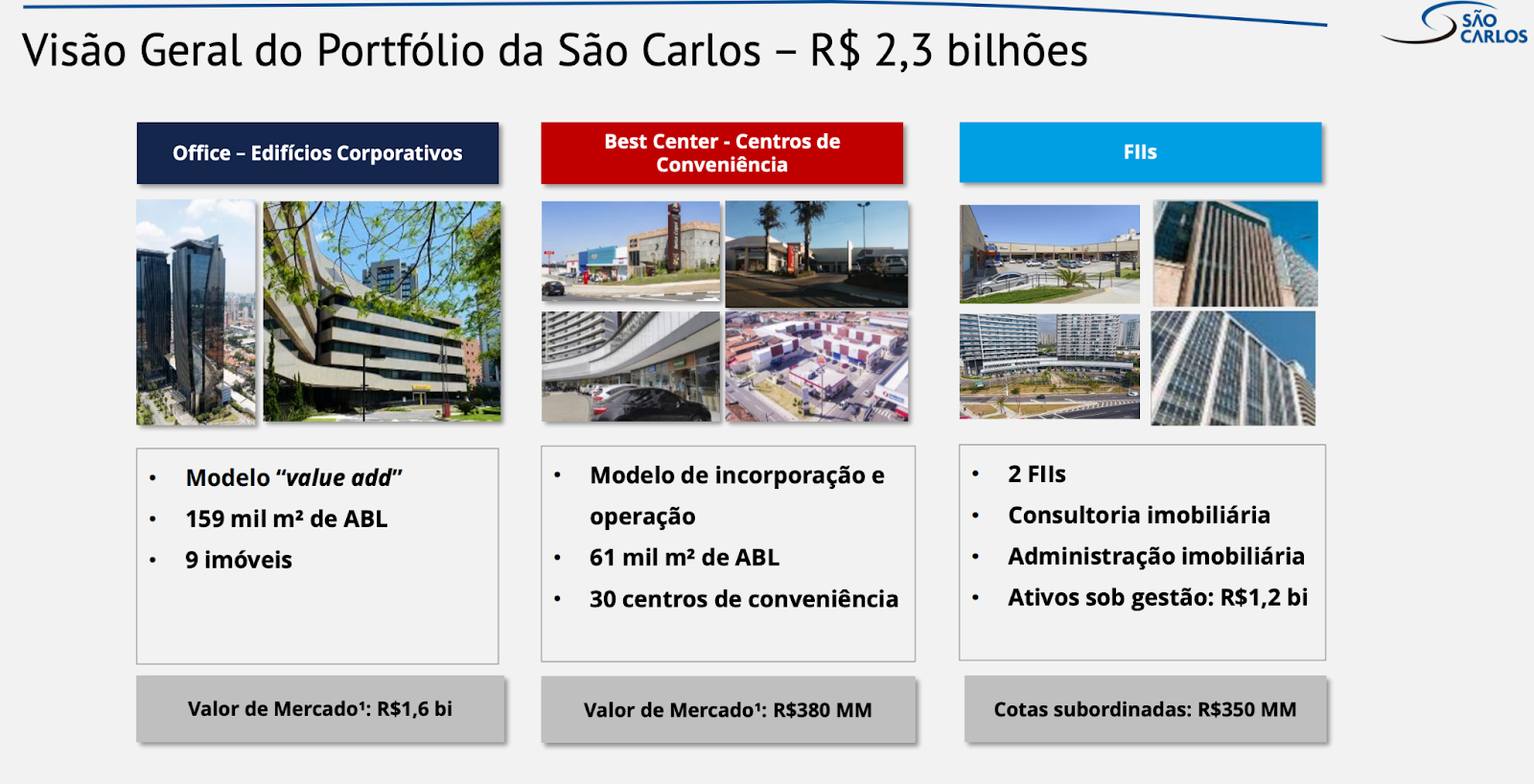
(Source: São Carlos, December’s Investor Presentation)
Valuation:
In terms of sources of value, I think about São Carlos today as a three-legged stool, namely: 1) the office properties they own, 2) retail properties (Best Center), and 3) ownership & management of FIIs. In the next few passages, I will break these segments to create a sum-of-parts valuation.
The Office Segment
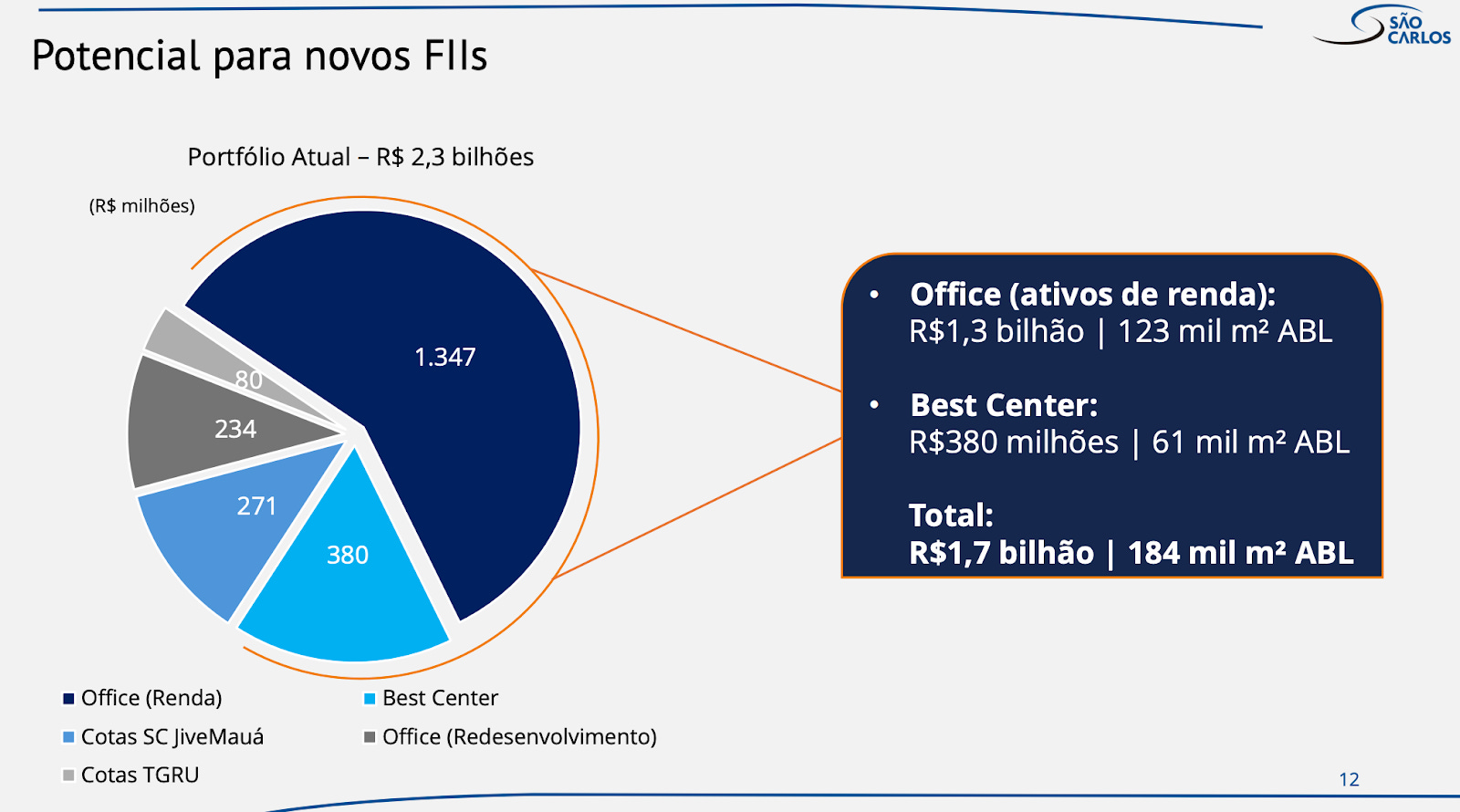
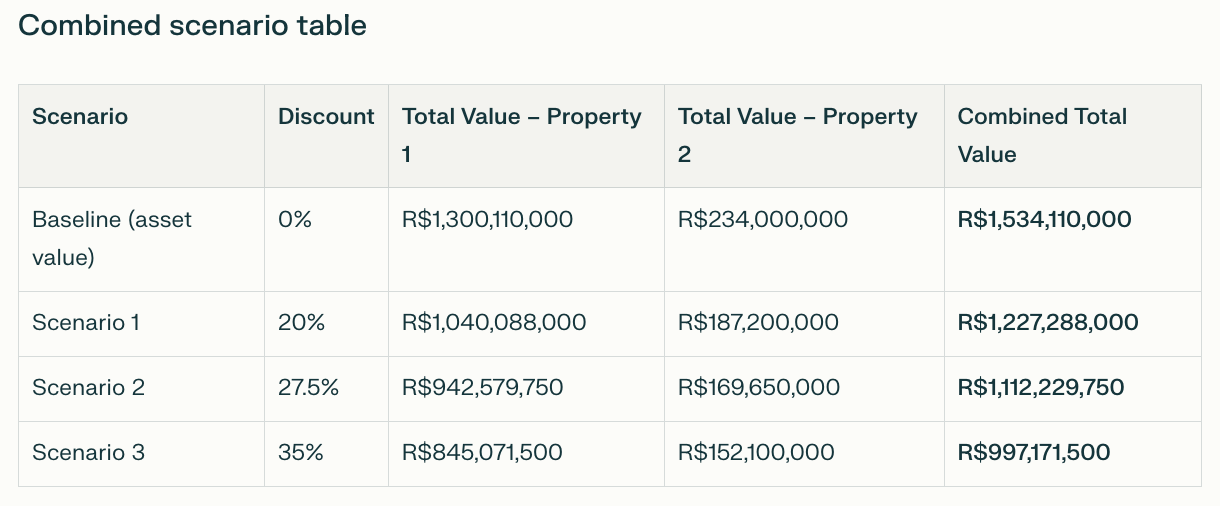
This is the largest segment in São Carlos’ portfolio and thus deserves special attention. As can be seen below, the office segment includes a number of office buildings with a gross leasable area of 159,000 m², of which ~ 123,000 m² is planned to be spun off to a REIT, and 36,000 m² of office space is intended for redevelopment due to reasons like age or not being a competitive space. An international consultancy firm conducts a yearly valuation; the current value sits at R$ 1.3 billion for the office space and R$ 234 million for the space meant for redevelopment.
(Source: São Carlos, December’s Investor Presentation)
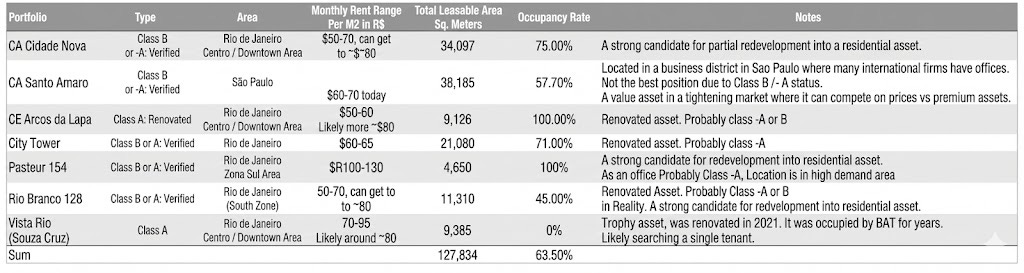
The office space that is currently still fully owned by São Carlos is largely located in the Rio de Janeiro Downtown area and is classified as Class A office space. Below you can see a representative list of the offices with research notes on rents and current occupancy rates. You can also scroll on São Carlos’ website for a deeper examination of each asset.
(Source: Author’s estimates based on reported figures and external sources)
It is known that consultancies tend to be overly optimistic when it comes to the valuation of assets, so the examination of their assumptions is warranted. The implied value of the office portfolio is R$ 10,570 / m² and R$ 6,500 / m² for the redevelopment assets.
São Carlos has been quite active in 2024; this provides us with some benchmarks to derive from. Recent assets were sold at an 18% discount to NAV, and from my research, there is no reason to believe that the current portfolio is more valuable. This is already useful information as it gives us a yardstick for future sales, assuming the macro environment stays similar.
When examining recent selling prices from the past 2-3 years of similar assets, we can benchmark against two similar deals in the area. The Edifício Sulacap deal that was sold by a competitor in March 2025 fits the type of assets in the São Carlos portfolio; older assets that underwent a comprehensive modernization to Class A grade in Rio’s downtown area. The price for that asset was ~ R$ 10,000 / m², 6% discount to NAV.
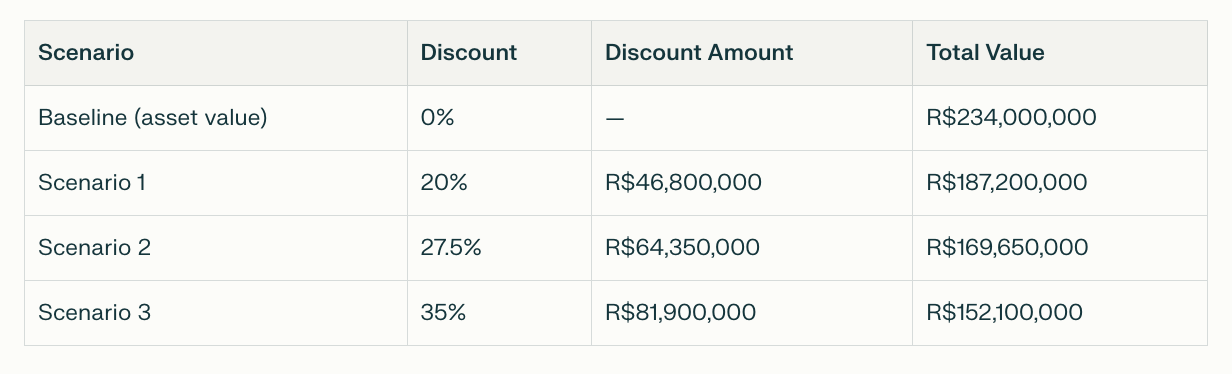
As for the redevelopment land, São Carlos sale of the Edifício Passeio 56 in January 2025 for conversion provides the framework for future deals where 6,602 m² were sold for R$21.7 million in cash, and São Carlos retained 30% stake for subsequent market sale. In other words, São Carlos received R$ 3,288 / m² in cash and kept ~ R$ 1,295 / m² in hidden upside, which totals R$4,583 / m². The original valuation of R$ 5,606 / m² reflects a NAV discount of 19%.
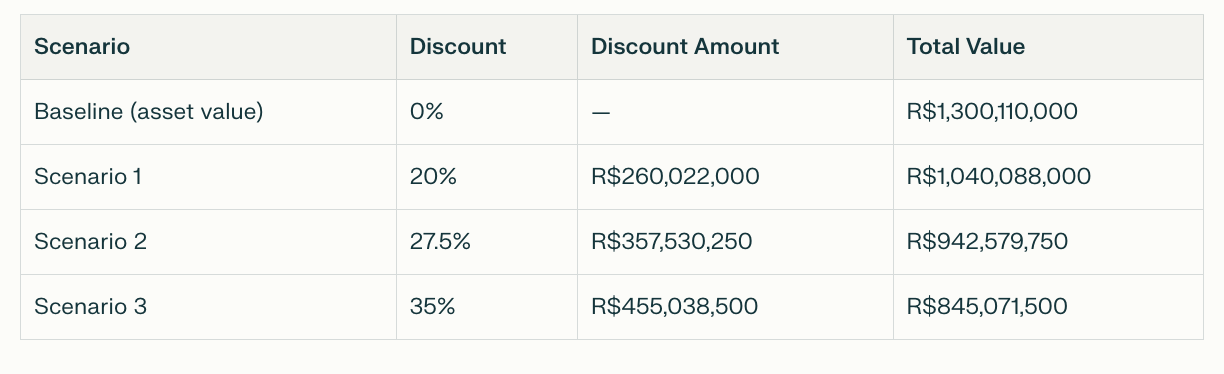
According to the model below, the likely asset value of both the office and redevelopment portfolios on a conservative discount to NAV valuation of 20-35% fluctuates between ~R$ 1 billion and R$1.25 billion:
Office Portfolio:
(Source: Author’s estimates based on reported figures)
Office Redevelopment Portfolio
(Source: Author’s estimates based on reported figures)
(Source: Author’s estimates based on reported figures)
Examining the cost of construction to estimate the replacement value, building a similar capacity of similar-grade office space in São Paulo (without land) would cost R$ 9.3-13K /m². In different consultancy reports, it was mentioned that the discount in costs between São Paulo and Rio de Janeiro is around 5-10% (~ R$ 8,400-12,000). This is also supported by Arcadis’ estimate of an approximately 7.7% cost premium for São Paulo compared to Rio de Janeiro.
It’s not easy to evaluate the replacement cost of land, especially in the Rio de Janeiro historical downtown area. What we do know is that it is significant. Developers’ standard negotiation in prime areas (like Rio or São Paulo) has centered on 20% of the GSV (Gross Sales Value).
The high replacement cost not only puts an effective cap on new capacity to be built as the market progresses towards a new equilibrium, but also provides a rough estimation of the potential value that can be unleashed. The construction cost of 123,000 m² of office space is around R$ 1-1.5 billion for the office space alone.
The figures above do not include the land cost that should add another R$ 250-350 million on a conservative basis, and the additional value from the redevelopment space that is valued at R$ 170 million after a 27.5% NAV discount. This puts the total replacement value of this segment alone at R$ 1.5 - 2 billion, a significant discount to the current enterprise value.
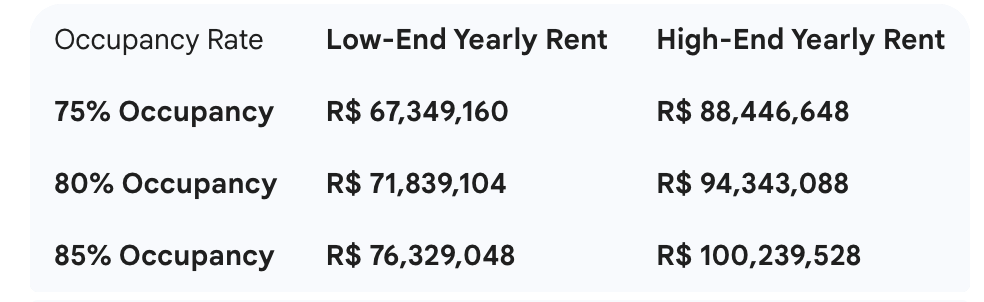
As for the income-generative potential of the office space in terms of rents, there is a significant room for improvement, as the current occupancy is at 63.5%:
(Source: Author’s estimates based on reported figures)
This is of course a theoretical income since some assets are likely to be converted into housing / mixed developments. Recently there were a few rumors of São Carlos being in advanced talks with several developers on this matter.
The Power Centers (Best Center)
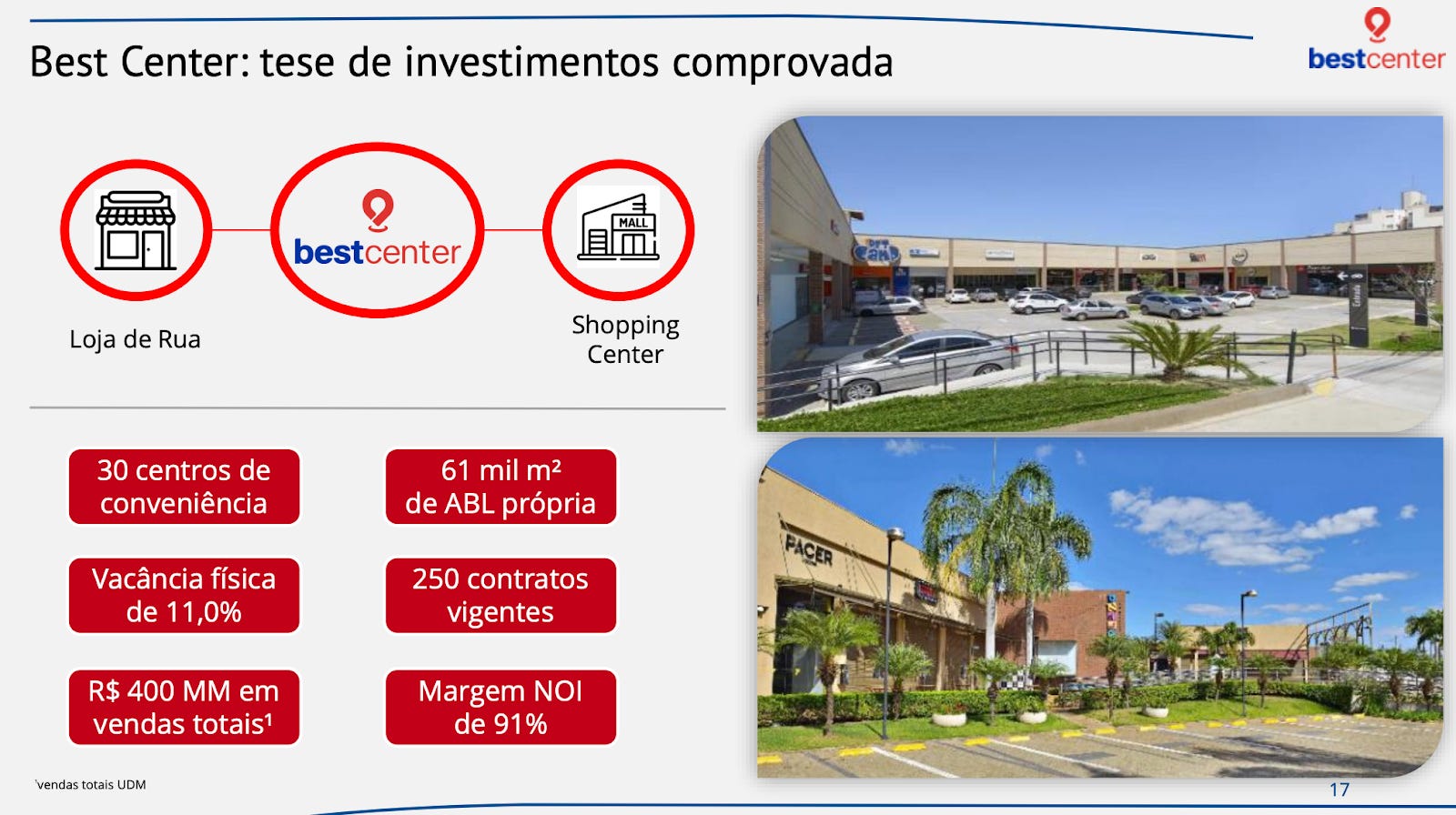
The Best Center segment refers to open-air retail complexes focused on everyday needs such as supermarkets, pharmacies, and essential services. They are located mainly in São Paulo and Rio de Janeiro high-traffic areas that attract steady daily foot traffic, and generate stable, predictable rental income even in weaker economic cycles.
Due to these characteristics, these centers enjoy high occupancy rates and stable renters. They are positively viewed by investors due to their predictability and inflation-indexed leases that provide real returns. São Carlos currently manages 30 open air convenience power centers, totaling 61,000 m² with occupancy rates of 89% across 250 active contracts.
(Source: São Carlos, December’s Investor Presentation)
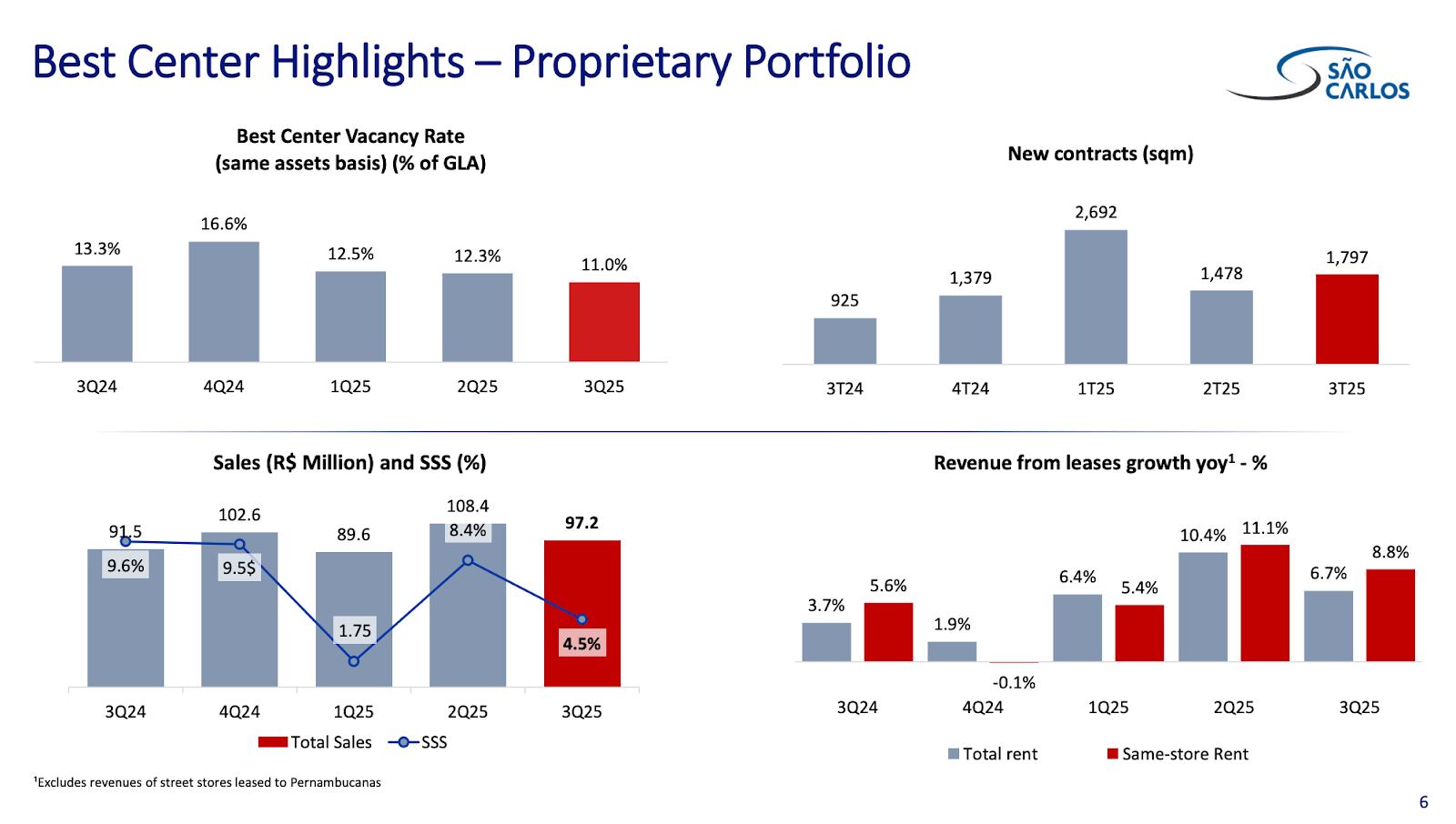
(Source: São Carlos, FY25 Q3 Investor Presentation)
The valuation is more straightforward to calculate given two deals that happened in 2024 and in 2025 when they sold and spun off part of their Best Centers subsidiary to FIIs. In both cases, they locked in favorable valuations: a cap rate of 8.9% for the first sale in 2024 in an all cash deal, and 8.7% for the second sale in 2025. The second sale had an interesting structure: composed of cash and subordinated shares that ensure they keep 90% of any additional upside (discuss the upside potential in the next section).
Based on Q3 results, the current NOI of the power centers is ~ R$ 26M, with 89% occupancy rate. If São Carlos is to increase the occupancy rate to 95% as they plan, the NOI would grow to ~ R$ 28M. With the current cap rate of 8.5-9.5%, the valuation of the assets would be at R$ 305-330 million.
REIT Management & Subordinated Shares Valuation
This segment is arguably the most interesting one in terms of the potential hidden value and structure. After years of significant undervaluation of its assets, in 2024 São Carlos has put their feet on the gas in terms of asset sales and spinning off assets. This section would focus on their change of strategy and role as a creator, consultant and shareholder of FIIs (REITs).
What stands out is the way these FIIs are structured: São Carlos serves as the consultant for these assets and thereby earning fees, maintaining operational control and releasing large sums of capital from its balance sheet.
One mental model to value the subordinated securities that São Carlos owns is to value it as an American call option that can be exercised at a favorable time up to and including the expiration date.
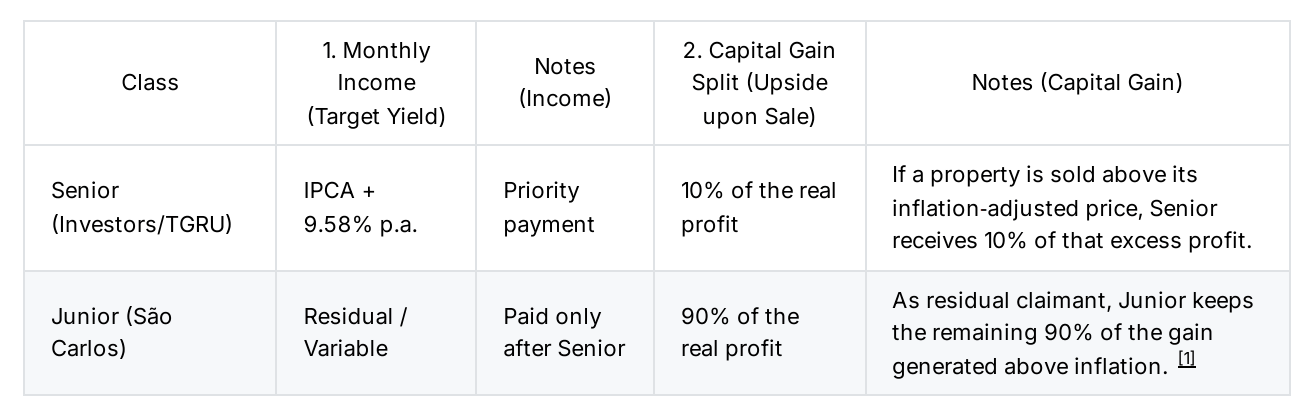
There are currently two FIIs that are structured in a way that the trust has to be liquidated within up to six to eight years depending on the security. The shares are divided into two classes, senior and junior: The senior class (the public) gets paid first, and it has to receive a targeted real yield that stems from rental income and asset sales. São Carlos’ junior security receives most of the excess profits above the targeted yield (>90%).
For example, the TGRU Renda Master holds 18 Best Centers (power centers). The promised real yield is 9.58% + inflation rate (IPCA). The ongoing NOI that the FII generates covers the promised yield to the senior investors.
To visualize it better, see the main characteristics outlined in the table below (TG Renda Urbana Feeder):
(Source: Author’s estimates based on reported figures)
In numbers:
Senior Principal: R$ 239.69 million.
Junior Principal: R$ 79.9 million.
Annual Cash Requirement: 9.58% of the principal equals 22.96 million per year.
Total NOI Generated: In November 2025, the portfolio’s total NOI was R$ 2.1 million (R$ 25.2 million normalized annually).
Occupancy Rate: 96.3%.
Maturity / Target: Any time within 5 years (+ 1 year for divestment, if needed).
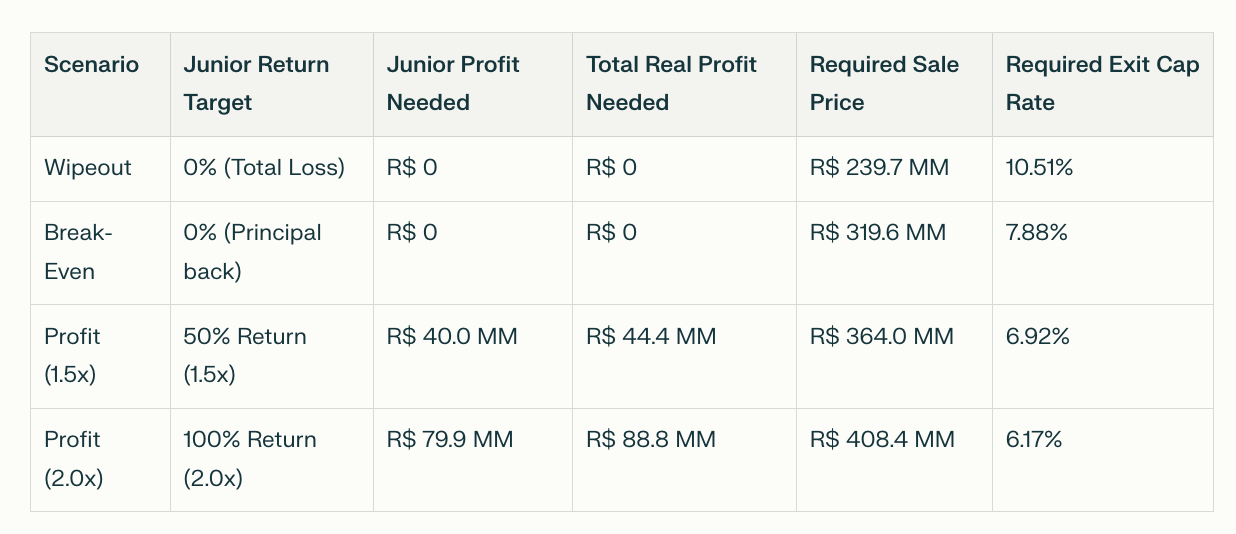
Valuing it as a call option, the Junior security is designed in a way where a loss is possible, but less likely due to a low strike price and long duration, where São Carlos can wait for six to eight years to sell the underlying asset at a favorable price. Thus, São Carlos has a high likelihood to break even and has some potential for significant returns in the case of real interest rate compression or a bull market that leads to higher NOI:
(Source: Author’s estimates based on reported figures)
I gave the FII TGRU Renda Master as an example, but São Carlos has another similar security; The FII SC JiveMauá Corporate created in December. Not all the details are out yet but a similar structure should be assumed where the company holds junior security (30%) and the senior security is held by the public (70%) with a promised yield that is covered by the NOI and has a long duration (7 years in this case).
To summarize this section, the junior securities are valuable and there is a high likelihood of breaking even / making a profit. Depending on one’s assumption, the value should be at least the book value of R$ 350 million, and a 50-100% upside is in the range of possible, depending largely on the compression of interest rates or improving of NOI.
Management:
I strongly believe that the best way to judge the quality of São Carlos’ management is by looking at two main variables. The first is by examining their track record as it relates to what they promised versus what they delivered, ensuring that they are not too promotional or committing to results that are not in their control. The second variable is carefully inspecting their incentives to understand their north star.
In São Carlos‘ case, there is a rare combination of a strong controlling shareholder group that understands incentives and a management team that showed ability to execute. The current management includes Gustavo Machado Mascarenhas serving as CEO and Fernanda Naveiro as CFO. They were appointed in January 2024 as part of a change in strategy for the purpose of extracting value from the heavily discounted stock price that in 2023 reached a low of 90% discount to NAV.
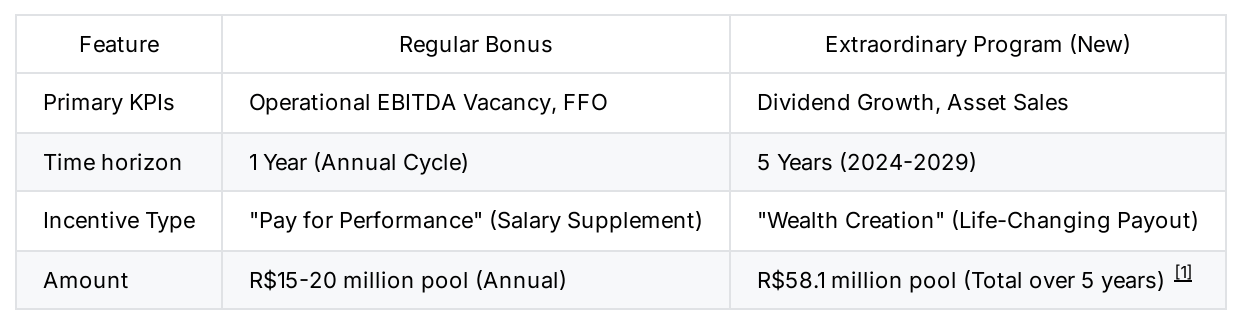
Both Gustavo and Fernanda come from the real estate sector where they gathered extensive experience in real estate and finance. Their compensation plan is built in such a way where the fixed pay is relatively low ~ R$ 2 million, but the yearly and 5-year variables are tied to specific KPIs that align with shareholder value.
These bonuses are very significant and are arguably life-changing sums. The KPIs are not fully disclosed but they relate to EBITDA growth, reducing vacancy rate, improving FFO, and sales of the real estate portfolio. If they execute on their targets they can receive an additional life-changing payout worth R$ 58.1 million over 5 years (See table below).
(Source: Author’s estimates based on reported figures)
We can see the results in action. Operationally, as of Q3 2025, they managed to increase NOI by 12.5% on the same asset basis. This rate is well above the inflation rate of 4-5% and showcases how management is focused not only on asset sales but also improving the current lease rates and properties.
As to asset sales, in 2024, they sold R$ 320.6 million with an average cap rate of 8.1%, the money was used for R$ 100 million dividend and debt reduction. In 2025, utilizing the REIT spinoff model they ramped up the asset sales to ~ R$ 1.2 billion with a cap rate of 8.3%. The capital returned to shareholders and again was wisely used: R$ 506 million was paid as dividends, R$ 350 million was invested in the new REIT junior shares and the rest went to leverage reduction and building its cash position.
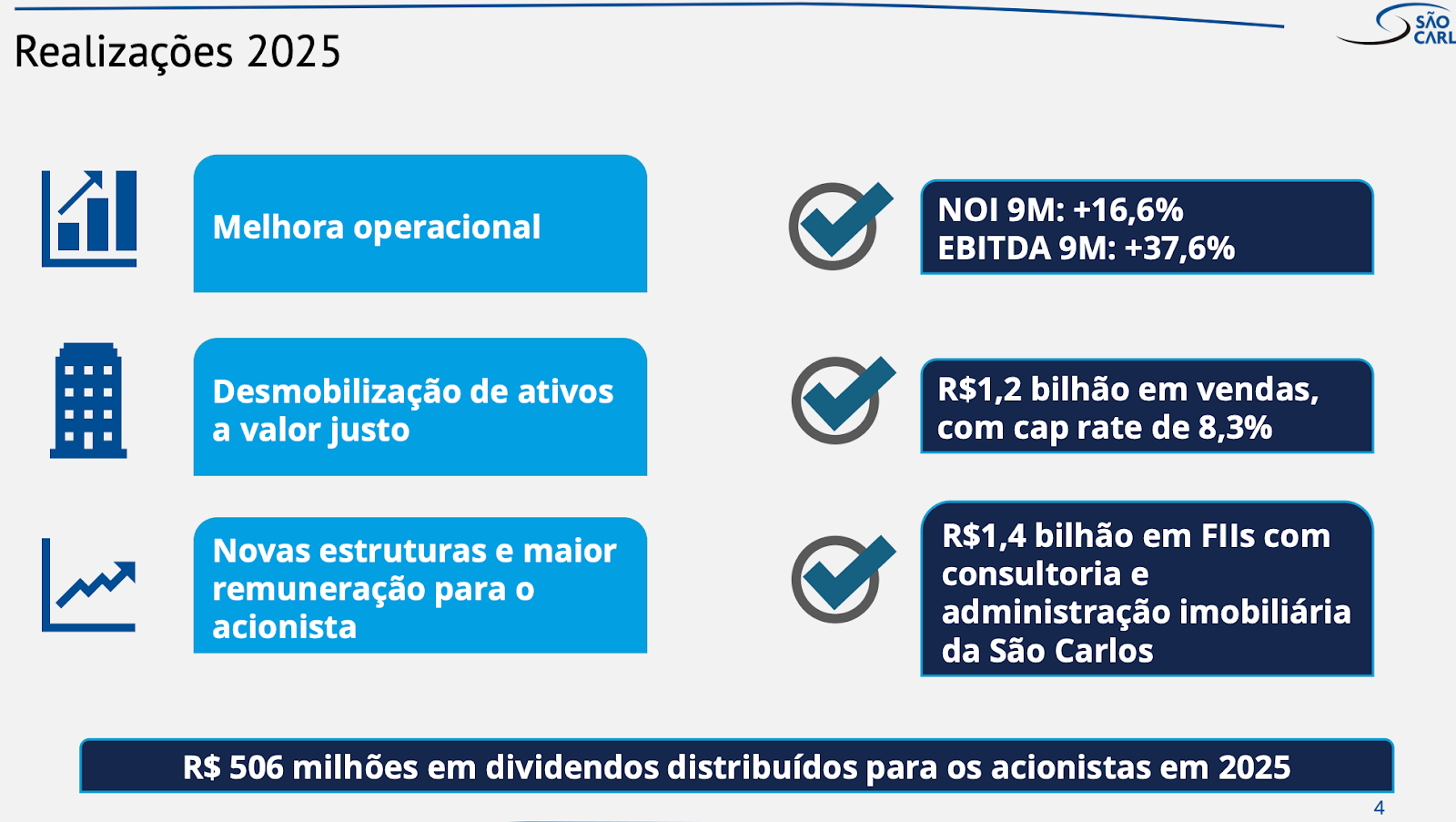
(Source: São Carlos, December’s Investor Presentation)
I think this execution speaks for itself and I’m looking forward to 2026 where further asset sales of the office space and Best Centers to FIIs vehicles are expected and the proceeds return to shareholders.
Price Versus Value
The current enterprise value after paying the large dividend in December and reducing debt levels is around R$ 900 million (167 million USD), where R$ 765 million is equity and R$ 145 million is debt.
No matter what numbers you choose to add, the current valuation reflects a large discount from intrinsic value. For example, in the base case presented below, I assumed the following:
A 27.5% discount to NAV for the office segment
The retail segment continues the current state with no improvements to cap rates
The subordinated shares are only worth their par (book) value.
In this case, São Carlos’ upside is more than 100%.
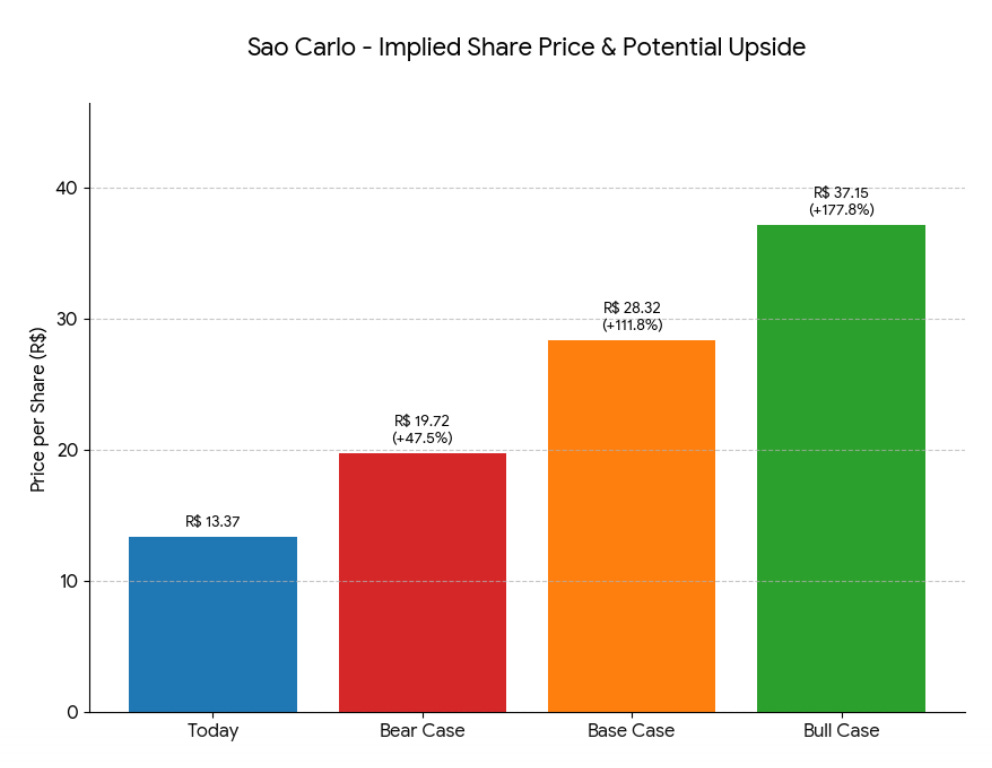
(Source: Author’s estimates based on reported figures)
If we assume something that resembles a fire sale, trying to liquidate the firm as soon as possible, selling the office assets and the retail assets at 35% discount to NAV, and giving R$ 0 to the subordinated shares, the value is around R$ 1.2-1.3 billion, still a ~47.5% upside from current prices.
This significant discount in valuation is the likely result of a few reasons. On a macro level, the office industry was and to some extent still perceived as doomed to be a dead sector that is struggling in the aftermath of COVID-19 due to the remote work trend. Additionally, the high interest rates, and uncertainty around the fiscal situation are impacting assets values in general.
On a security specific level, causes such as being a C-corp and not a REIT, complexity of valuing the subordinated shares, and the firm being a micro cap that is thinly traded doesn’t help the valuation.
A few words on the macro situation:
Let me start by saying that I am neither a macro nor a Brazil expert - I tend to focus my efforts on the company-specific situation. However I do believe that Brazil’s macro situation is a unique one and as such deserves special attention as it might impact the prospective investor’s capital allocation.
The Macro situation in Brazil should be examined from an operational and a financial point of view. From an operational perspective, we are in an upward bullish cycle as it relates to retail space. The retail environment is overall strong and resilient, characterized by demand from consumers, high occupancy rates, and limited new supply due to high interest rates and uncertainty. The situation creates a ‘landlord’ market in strong locations where rent increases exceed the inflation rate.
When it comes to offices, it is more area-dependent. Not a peak yet, but overall, there is a significant recovery in some areas. Vacancy rates have decreased significantly from the COVID-19 peak due to different trends such as return to office policies and ‘flight to quality’, as tenants are moving from Class B and C to Class A or triple A buildings.
In São Paulo, vacancy in prime areas has plummeted to ~16%, the lowest in 14 years. Secondary markets such as Rio de Janeiro saw massive improvements but vacancies are still in elevated numbers overall, with vacancy down from 40% to ~28% since COVID-19. In Rio authorities have been involved in curtailing the oversupply in the city center area, and are offering significant tax benefits to developers who convert office spaces into housing.
The other side of the coin is the financial one. The dry numbers tell much of the story, 15% short term interest rates, ~4% inflation and ~7-8% long term real rates. For a developing economy such as Brazil, these numbers imply very high uncertainty and fears of debt crisis and rising inflation.
To contextualize this, short-term inflation adjusted risk-free interest rates are at a multi-year high. Brazil’s real interest rates are the 2nd highest in the world behind only Russia, which is managing a war economy. In 2024, the Selic (short term) rate was ~12%, and the market actually expected a decrease to 9%. Instead, the central bank has increased the short-term rates to 15%, citing fiscal concerns.
The concerns and uncertainty stem from a few reasons, namely Brazil being structurally leaning towards inflation since a lion’s share of the government’s expenditures are linked to inflation in the constitution (health, education, infrastructure etc.). On the other side of the equation, tax revenues are not growing at the same rate. Under a left governing government which prioritizes social plans, Brazil has already reached 76-78% debt to GDP ratio and is forecasted to get to 90-100% by 2029.
You can see below the long term history of real rates in Brazil, and observe that we are almost six years into a tightening interest rate cycle:
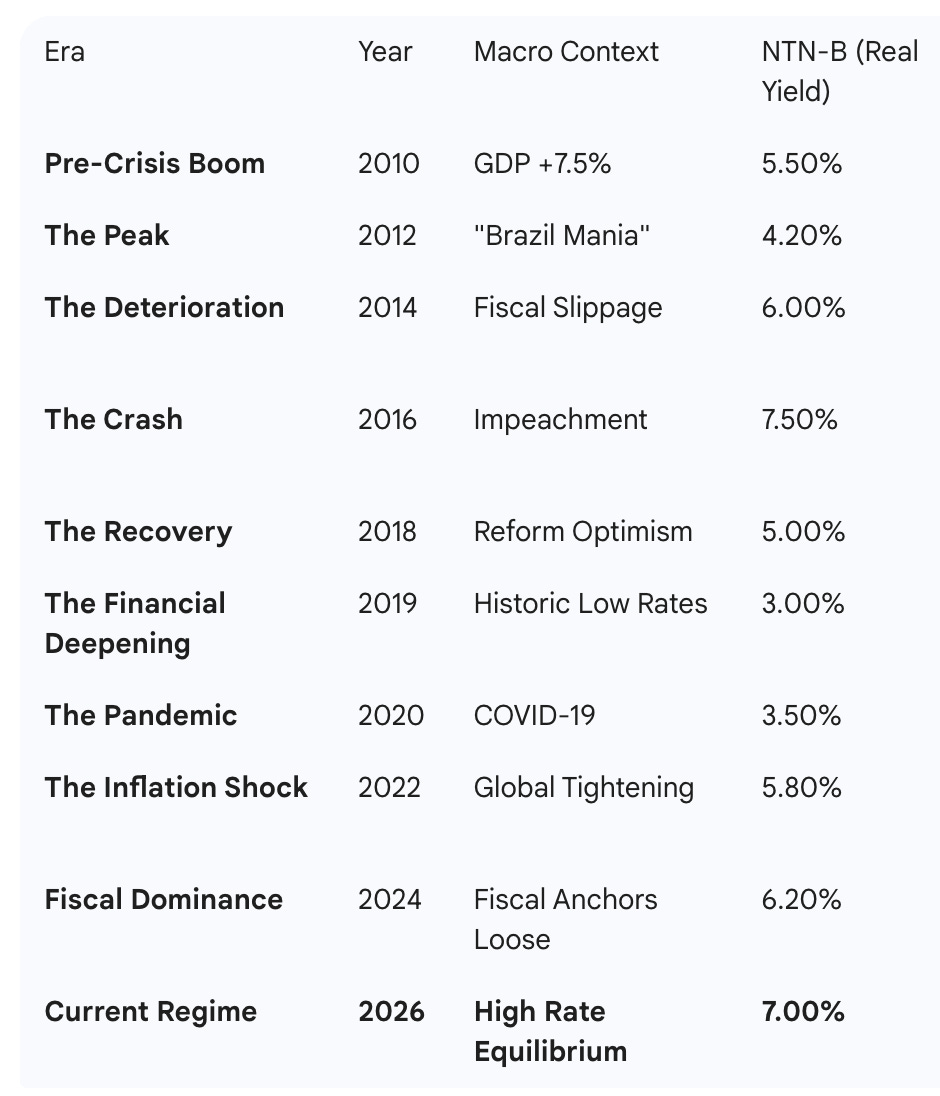
(Source: Author’s estimates based on reported figures)
This means that tough decisions would have to be made soon. Either increasing tax revenues and depressing consumption or passing an unpopular bill, changing the constitution and cutting health / education expenses. In addition, there is a presidential election in 2026 that comes with uncertainty as to the route the next president would take.
Investors have doubts that these issues are going to be resolved any time soon, assuming a debt crisis situation and thus demand high real interest rates to compensate for their risks. This is also where the risk lies: staying at high rates for longer or operational deterioration would negatively impact assets valuation.
My take on it is to acknowledge the specific country risk Brazil is posing and account for it. As Buffett once said, everyone knows that a 70 year old has a higher probability of dying at any given day than an 18 year old, and thus the 70 year old is more risky. A life insurance company that needs to underwrite longevity risks has to ensure it doesn’t offer the 18 year old a 70 year old rate, and more importantly that the 70 year old won’t get an 18 year old rate.
I believe that due to the current valuation, the management track record and activism, and the asset quality, a prospective investor is more than adequately compensated for the Brazil country factor.
Conclusion:
São Carlos at the current valuation offers an asymmetric bet with 2-3x potential returns and high margin of safety. This includes a strong management team with its incentives aligned and skin in the game in the form of substantial payoff if they surface value, controlling shareholders with a long track record of generating wealth, deeply undervalued assets that are recovering.
Adding to this, extremely low leverage that allows them to wait the storm out, some tailwinds and trends such as ‘returning to the office’, ‘flight to quality’, and the prospect of interest rates compression if a debt crisis does not materialize.
Risks:
Any change in management strategy should be scrutinized. This is very unlikely as the wheels are already in motion and the track record of management / controlling shareholders.
Recession or macro headwinds where interest rates stay higher for longer or increasing vacancies is mainly a timing risk of execution and not permanent capital loss risk due to the low leverage of the company. In other words, the potential downside is not insolvency but a prolonged period of value realization that depresses IRRs despite asset coverage.
Disclosure & Disclaimer
I currently hold a long position in West Fraser (WFG) and may buy or sell shares at any time without notice. This article reflects my personal opinions and is for informational purposes only. It is not financial or investment advice. Readers should do their own research or consult a qualified advisor before making investment decisions.